Entrepreneurship & Strategy

Start with a Minimal Product: Do Not Let Preparation Become an Excuse

Share this article
LINEFacebook

Notes from Dedao’s audio summary of 精進, with Robin’s commentary

Storage information

Bookmarks and reading positions are stored in this browser. Manage and back them up in My Reading.

Collected in Robin Shen’s Field Notes · Content type and attribution are shown above

English translation of the Chinese post originally published 2026-10-10. Translated 2026-11-05 with AI assistance. Historical figures and claims have not been updated or independently verified. 中文原文

Reading guide

This summary of Dedao’s discussion of 精進 warns against preparing forever without finishing. A minimal product need not be a complete company or complex software; it can be a structured account of experience that others can use. Deliver something first, then improve it through feedback. Robin adds: learn and adjust by doing, rather than making unreadiness an excuse. The Thiel program described uses its early under-20 design; later rules differ, as explained in the source note. This is not encouragement to leave college and start a company without assessing the risks.

Key points

  • First complete a small, usable output that carries your ideas.
  • Improve through feedback instead of preparing indefinitely.
  • Robin: learn and adjust by doing; do not let unreadiness block action.
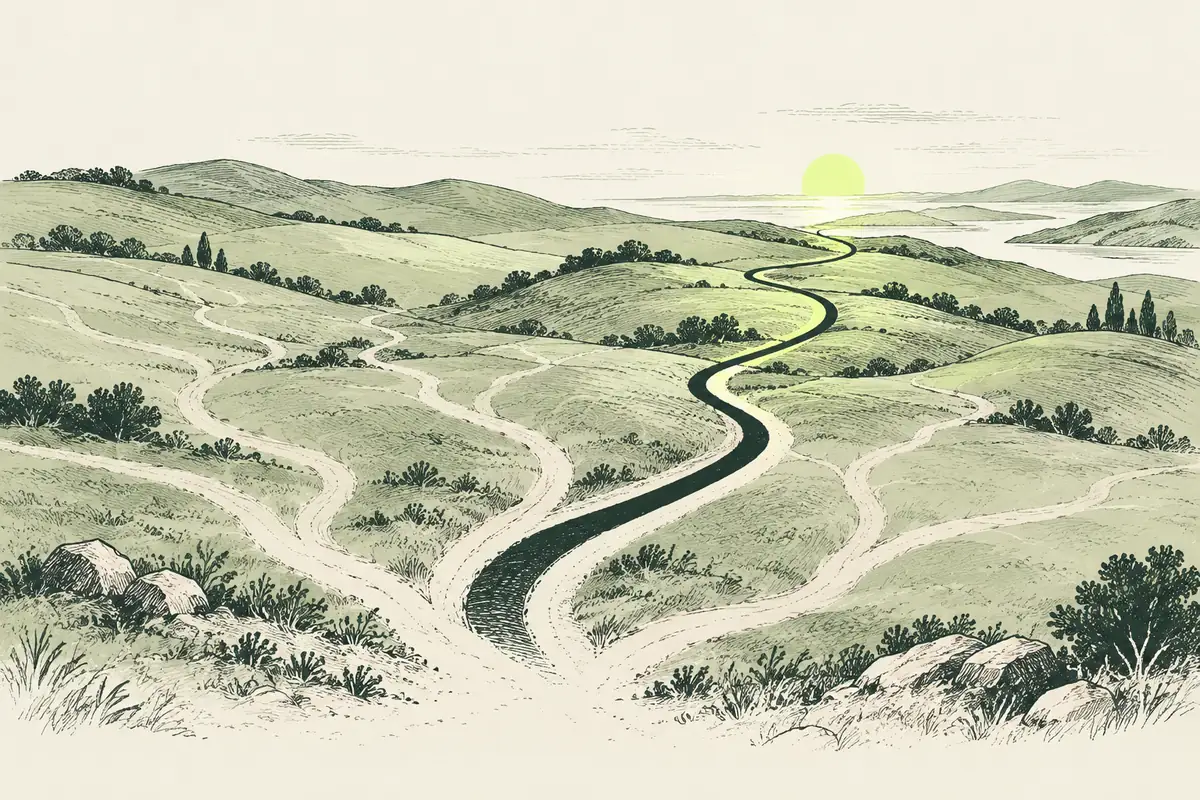
One clear path continues into the distance among several branching routes, suggesting choice and focus.
Entrepreneurship & strategyThematic illustration · AI generated

Full text — English translation

Seven Ways to Become More Capable—How to Act Complex things are usually difficult to fully understand at the outset. Strategy is only a broad direction. Once you have thought something through, the most effective approach is to begin immediately, doing and refining it bit by bit. Avoid excessive preparation. Traditional education contains an implicit habit of incompletion. Schools treat knowledge as preparation for the future, rather than a means to accomplish something now. From primary school through secondary school, college, and a doctorate, people spend years preparing. That prolonged preparation creates inertia: never completely finishing a task or producing a finished product. Without experiencing the achievement of completion, people use being unprepared to avoid difficulty. In today’s environment, waiting until everything is ready may mean missing the opportunity. Nobody can prepare completely. The best approach is to enter the arena. You may take some hard knocks initially, but this can be the fastest way to improve. Peter Thiel established a fund providing startup money each year to twenty college dropouts under twenty. Harvard’s president criticized the program as blatantly misleading students into entrepreneurship. But learning through practice is also learning. Who knows what people outside traditional education from an early age might accomplish? How do you overcome excessive preparation? First, make a minimal product. With no resources, how? Anything structured that carries your thinking and can be used by others counts. An internship itself is not a product, but a systematic account of its lessons can be. Reading a book is not a product, but an insightful analysis of it is. These are not complex products, but minimal ones that can be developed and improved. Through that vehicle, your abilities, reputation, influence, and sense of achievement gradually grow. Have the courage to make and release that first minimal product. Continually revise it through criticism and feedback, iterating quickly. That is the right approach to rapid action. Work has techniques and methods. A capable person never stops exploring how to improve the steps. #Dedao audio summary of 精進 ---- Robin: ‘Begin. Keep learning and adjusting through doing. Do not let being unprepared become an obstacle or excuse.’

These articles are personal notes, book excerpts, and collected reprints. Figures and events reflect the time of the original publication, are not current information, and do not constitute investment advice.

Share this article
LINEFacebook

DISCUSSION

Reader comments

What did this article make you think about? Different perspectives and constructive criticism are welcome.

Comments are public immediately. Do not include personal contact details or external links. Automated checks block suspicious solicitation, prohibited transactions and spam; they can make mistakes.

0 / 2000

Comments load when you reach this section.

    Administrator sign-in

    My reading notes

    These notes stay in this browser and are not published. Writing a note also saves the article. Back up or move your notes in My Reading.

    Manage my bookmarks and notes →

    STAY CURIOUS

    Save a good question for your next visit.

    Save this article, or follow the Facebook page and RSS feed for additions. Historical articles retain their original publication dates.

    Browse All articlesSearch articles and full text →